

Buffet vs. Sideboard vs. Credenza: What’s the Difference?

Buffet vs. Sideboard vs. Credenza: What’s the Difference?
Inside, you’ll commonly find:
Drawers for silverware and serving utensils
Cabinets for dishes and glassware
Shelves for serving pieces
Storage for table linens
Large open compartments
The top surface also gives you extra room when entertaining.
Instead of crowding the dining table with serving dishes, food could be arranged on the buffet so guests could serve themselves.
That connection to food service is where the term buffet became strongly associated with dining-room furniture.

Where does a buffet normally go?
Traditionally:
In the dining room.
But modern homeowners use them almost anywhere.
A refinished buffet can work beautifully as a:
Dining room storage cabinet
Entryway console
Living room cabinet
Coffee or beverage station
Home bar
Media console
Kitchen storage cabinet
That versatility is one reason older buffets are some of our favorite pieces to restore.
What Is a Sideboard?
A sideboard is extremely similar to a buffet.
In fact, in modern furniture stores, the words buffet and sideboard are often used interchangeably.
Historically, however, the terminology was slightly different.
A sideboard was generally placed along the side of a dining room and used to store dishes, silverware, serving pieces, and other dining essentials.
Hence the name:
Side + board.
It was essentially a storage and serving surface positioned along the side of the room.
Buffet vs. Sideboard
Traditionally, one of the commonly cited distinctions was the furniture's construction.
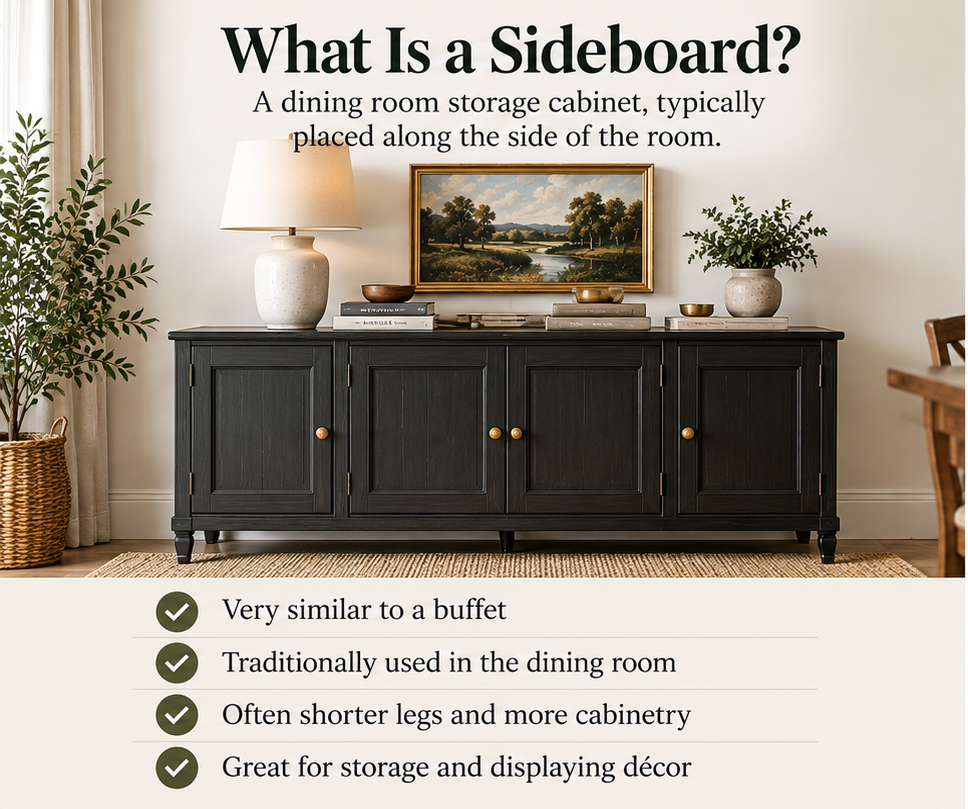
Buffets were sometimes built with slightly taller legs, while sideboards tended to have:
Shorter legs
More cabinetry reaching toward the floor
A heavier visual appearance
But this is far from a perfect rule.
Furniture manufacturers have used the terms inconsistently for decades.
Today, the biggest distinction is often simply how the manufacturer or seller chooses to describe the piece.
If you see a long cabinet with drawers and doors designed for dining-room storage, calling it either a buffet or sideboard will usually be understood.
What Is a Credenza?
The word credenza originally referred to a different style of furniture, although its meaning has evolved significantly.
Modern credenzas are typically:
Long
Low
Sleek
Cabinet-heavy
Designed with little or no visible leg height

Compared with traditional buffets and sideboards, credenzas often have a more modern or mid-century appearance.
They frequently feature sliding doors, cabinet compartments, shelves, and a relatively simple silhouette.
Because of that design, credenzas became popular outside the dining room.
You'll commonly see them used in:
Living rooms
Offices
Conference rooms
Entryways
Dining rooms
Entertainment spaces
A credenza can store almost anything while providing a large decorative surface.
The Simple Difference
If you want the easiest way to remember the three terms, think of them like this:
Buffet
Traditionally a dining room storage and serving cabinet.
Sideboard
Also traditionally a dining room storage cabinet, usually positioned along the side of the room.
Credenza
Generally a lower, longer cabinet, often associated with modern living rooms, offices, and dining spaces.
There are exceptions to every one of those descriptions.
Modern furniture terminology has blurred the boundaries considerably.
Why Do Furniture Stores Use the Names Interchangeably?
Furniture has changed.
Homes have changed.
And the way people use rooms has changed.
Older homes frequently had dedicated dining rooms where large furniture pieces had very specific purposes.
Modern homes are often more flexible.
A cabinet that once stored formal china might now hold:
Board games
Electronics
Books
Barware
Coffee supplies
Children's toys
Extra kitchen appliances
Because the furniture itself has become more versatile, the terminology surrounding it has become less strict.
Retailers also use different names depending on what customers are searching for.
The same basic piece could reasonably appear online as a:
Buffet, sideboard, credenza, console cabinet, dining cabinet, storage cabinet, or server.
None of those names necessarily means the listing is incorrect.
What About a Server?
There is another furniture term you'll occasionally encounter:
Server
A dining server is similar to a buffet but is often:
Smaller
Taller
Narrower
Designed specifically for serving food or storing dining accessories
Servers frequently include drawers for silverware and cabinet storage underneath.
Like the other terms, however, modern furniture manufacturers don't always follow strict definitions.
How Can You Tell What an Older Piece Originally Was?
When we restore older furniture at Brickhouse & Baron, the original design often provides clues about how a piece was intended to be used.
Here are some things we look for.
Velvet or Felt-Lined Drawers
Small felt-lined drawers may have been designed for:
Silverware
Serving utensils
Flatware
Delicate dining accessories
Some older buffets even include specially shaped silverware organizers.
Large Center Cabinets
Buffets and sideboards often include large cabinet areas designed to hold:
Serving platters
Bowls
China
Glassware
Table linens
Long, Wide Tops
A large surface was valuable because the furniture wasn't only designed for storage.
It was also designed for serving food and displaying dishes.
Decorative Hardware
Older dining furniture was frequently designed to be displayed prominently.
That means you'll often find:
Ornate brass pulls
Detailed drawer fronts
Decorative legs
Carved trim
Veneer patterns
Solid wood tops
Those details are one reason vintage dining furniture can make such striking statement pieces after restoration.
Which One Should You Buy?
Instead of focusing too heavily on what the furniture is called, focus on how you plan to use it.
Ask yourself a few questions.
How much storage do you need?
If you have a large collection of dishes, cookware, or table linens, look for a buffet or sideboard with:
Multiple drawers
Deep cabinets
Adjustable shelves
Wide storage compartments
How much space do you have?
Before purchasing, measure:
Width × Height × Depth
Depth is especially important.
Large antique buffets can sometimes be significantly deeper than modern cabinets.
Make sure you'll still have comfortable walking space around the piece.
Do you want storage or display space?
Some pieces emphasize cabinet storage.
Others provide huge surfaces for decorating.
A long buffet can become a great place for:
Lamps
Artwork
Mirrors
Plants
Seasonal décor
Family photos
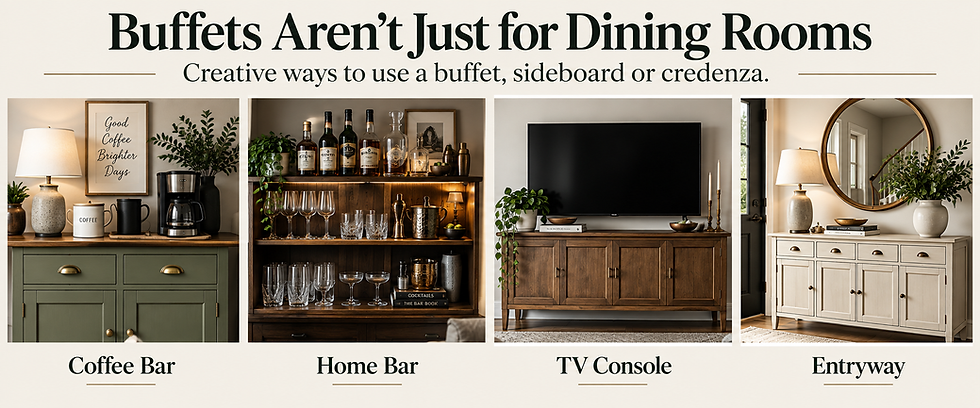
Buffets Aren't Just for Dining Rooms Anymore
One of the biggest advantages of buying a buffet, sideboard, or credenza is versatility.
We regularly see customers use these pieces in completely different ways than their original designers probably imagined.
Use One as a Coffee Bar
Add your:
Coffee maker
Mugs
Syrups
Coffee beans
Tea
Accessories
Everything can stay organized inside the cabinet while the coffee station remains on top.
Use One as a Home Bar
Deep cabinets and drawers make many vintage buffets perfect for storing:
Glassware
Cocktail tools
Bottles
Napkins
Serving accessories
Use One as an Entertainment Console
Long credenzas and sideboards can make excellent TV stands.
The cabinets provide storage for:
Game consoles
Controllers
Movies
Cables
Electronics
Just make sure there is adequate ventilation for electronic equipment.
Use One in an Entryway
A sideboard can create a dramatic entryway while giving you hidden storage for everyday household items.
The top provides plenty of room for:
Lamps
Keys
Décor
Plants
Mirrors
Seasonal displays
Vintage Buffets Can Offer Incredible Storage
One reason we enjoy restoring older buffets and sideboards is their construction.
Many vintage pieces were built when large dining-room furniture was expected to hold substantial amounts of weight.
Depending on the piece, you may find:
Solid wood construction
Hardwood drawer boxes
Dovetail joinery
Heavy-duty hardware
Thick wood tops
Deep drawers
Large cabinet compartments
Of course, age alone does not guarantee quality.
Every piece should be inspected individually.
But well-built older furniture can offer an impressive combination of storage, character, and durability.
So… Buffet, Sideboard, or Credenza?
Here's the important part:
Don't get too caught up in the label.
Furniture terminology has changed so much that two nearly identical pieces may be listed under completely different names.
Instead, focus on:
Construction quality
Storage capacity
Dimensions
Condition
Style
How the furniture fits your home
Whether you call it a buffet, sideboard, credenza, server, or storage cabinet, the right piece can become one of the most useful pieces of furniture in your home.
Give an Older Piece a New Life
At Brickhouse & Baron, we restore and refinish furniture that still has plenty of life left in it.
Buffets and sideboards are some of our favorite pieces because their combination of storage, craftsmanship, and character makes them incredibly adaptable to modern homes.
A piece originally built for a formal dining room decades ago can become today's:
coffee bar, entryway cabinet, entertainment console, home bar, or statement storage piece.
Explore our current collection of refinished furniture and see what could work in your home.


Comments