

Solid Wood vs. Particle Board Furniture: What Should You Buy?

Two dressers can look almost identical.
Same size. Similar finish. Same number of drawers.
But one might still be in a bedroom 20 years from now, while the other may struggle through its second move.
The difference is often what’s underneath the finish.
Modern furniture can be made from solid wood, particle board, MDF, plywood, veneer—or a combination of several materials. None of these materials automatically makes a piece good or bad, but they can make a significant difference in durability, repairability, price, and lifespan.
At Brickhouse & Baron Furniture, we work with furniture after it has already experienced years—sometimes decades—of real use. We see what survives, what fails, what can be repaired, and what is worth restoring.
So before buying your next dresser, table, buffet, or nightstand, here's what you should know.
The Short Answer
If you're looking for furniture you want to keep, repair, move, and potentially refinish years from now, solid wood is usually worth considering.
If you need something affordable for temporary or lighter use, particle board can make perfect sense.
MDF sits somewhere in between. It's smooth, dense, and excellent for certain applications—particularly painted furniture—but behaves differently from natural wood.
The best material depends on what you're buying, how you'll use it, and how long you expect to keep it.

At Brickhouse & Baron Furniture, we spend a lot of time working with existing furniture. We see pieces after years—and sometimes decades—of actual use. We sand them, repair them, refinish them, replace hardware, rebuild damaged areas, and prepare them for their next home.
That gives us a different perspective on furniture quality.
So, if you're deciding between solid-wood furniture and particle-board furniture, here's what you should know.
What Is Solid-Wood Furniture?
Solid-wood furniture is constructed primarily from natural lumber rather than wood particles that have been broken down and bonded back together.
Depending on the piece, you may encounter hardwoods such as oak, maple, walnut, cherry, mahogany, or poplar, as well as softer woods such as pine.
That doesn't necessarily mean every component of a piece labeled "solid wood" will be made from the same material. Even high-quality furniture can contain plywood backs, drawer bottoms, veneers, or other engineered components where they make structural or practical sense.
The important distinction is that the primary structure is built from substantial wood components.
And that matters.
Natural wood can often be sanded, repaired, stained, painted, refinished, and modified repeatedly throughout its life.
A dresser built decades ago may look outdated today, but underneath an old finish may still be an incredibly strong piece of furniture.
That's one of the reasons we love restoration.
Good furniture doesn't necessarily become bad furniture just because its style becomes outdated.
Sometimes it simply needs another chapter.
What Is Particle Board?
Particle board is an engineered material manufactured from small wood particles—such as chips, shavings, and sawdust—that are combined with adhesive and compressed into panels.
Those panels can then be covered with laminate, melamine, printed finishes, or wood veneer to create the appearance of finished furniture.
Particle board has an important advantage: cost.
Manufacturers can produce large quantities of furniture relatively inexpensively while maintaining consistent shapes and dimensions.
That's one reason particle-board furniture has become so common in affordable ready-to-assemble furniture.
And particle board isn't automatically "bad."
For certain situations, it makes perfect sense.
A temporary apartment, college dorm, rental property, home office, or room that you expect to redesign soon may not require a piece of furniture intended to survive for generations.
The problem occurs when inexpensive engineered furniture is expected to perform like traditional solid-wood furniture.
Those are two very different products.
Durability: Where the Difference Becomes Obvious
One of the biggest advantages of solid wood is its ability to tolerate everyday life.
Furniture gets bumped.
Drawers get slammed.
Children climb on things they shouldn't.
Dressers get moved between bedrooms.
Tables get scratched.
Hardware loosens.
Corners get damaged.
And eventually, somebody decides the entire room should be rearranged.
Solid wood generally gives you much more material to work with when something goes wrong.
A loose screw can often be repaired.
A scratched surface can often be sanded.
A damaged finish can often be removed.
A chipped corner may be rebuilt.
A drawer can sometimes be repaired rather than discarded.
Particle board is less forgiving.
Once the compressed material around a screw begins crumbling, simply reinstalling the screw may not solve the problem. Significant water exposure can cause swelling. Damaged laminated surfaces can be difficult to repair invisibly.
This doesn't mean every solid-wood piece is indestructible or every particle-board piece is fragile.
Construction quality matters enormously.
But when we're evaluating furniture for restoration, repairability is one of the biggest differences we notice.
Solid Wood Can Have More Than One Life
This is where older furniture becomes especially interesting.
Imagine a dresser originally purchased decades ago.
The finish becomes scratched.
The hardware looks dated.
The stain no longer matches modern interiors.
Eventually, somebody decides they don't want it anymore.
From a style perspective, the dresser may be outdated.
Structurally, however, it may still be excellent.
That creates an opportunity.
The old finish can be removed or prepared.
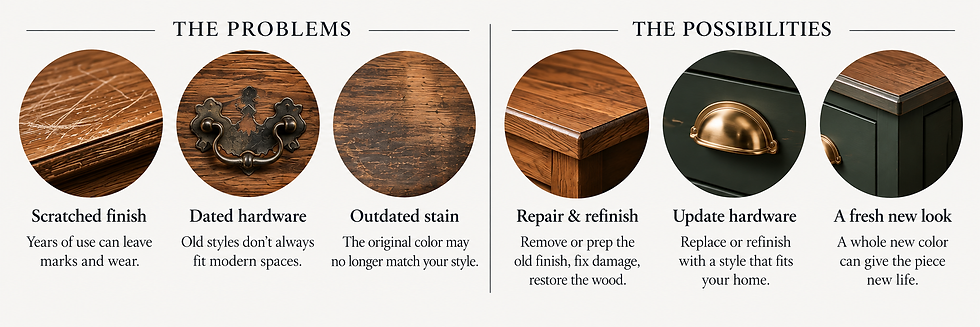
Damage can be repaired.
Hardware can be replaced or refinished.
The body can receive a completely different color.
A natural wood top can sometimes be restored and stained.
Suddenly, a dresser that looked like it belonged several decades in the past can work beautifully in a modern bedroom.
That ability to reinvent furniture is one of the foundations of what we do at

Brickhouse & Baron.
We're not simply painting old furniture.
We're looking for pieces with enough underlying quality to deserve another life.
How Can You Tell If Furniture Is Solid Wood?

There isn't one perfect test, but several clues can help.
Look at the grain.
Real wood grain naturally changes across the surface. Printed or laminated wood patterns may repeat.
Look at exposed edges.
The back, underside, drawer openings, and interior edges often reveal what is underneath the finished surface.
Examine the back.
Older solid-wood furniture frequently has very different construction from inexpensive modern flat-pack furniture.
Remove a drawer.
Look at the drawer sides, bottom, and joinery.
Traditional dovetail joints can be a good sign of more substantial construction, although dovetails alone don't guarantee that the entire piece is solid wood.
Look inside damaged areas.
Ironically, scratches and chips can reveal a lot.
A damaged laminate corner may expose compressed particles underneath, while damage to solid wood will generally reveal more wood.
Check the hardware.
Older furniture sometimes uses substantial metal hardware and construction methods that provide clues about its age and quality.
No single feature tells the whole story.
Think of furniture inspection as collecting evidence.What About Veneer?
Veneer deserves special attention because it is frequently misunderstood.
Some people hear "veneer" and immediately assume cheap furniture.
That's not necessarily true.
Wood veneer is a thin layer of real wood applied over another material. Veneering has been used in furniture construction for centuries, including on many high-quality and valuable pieces.
A well-built vintage dresser might combine solid-wood structural components, plywood panels, and beautiful wood veneer.
That's very different from inexpensive furniture covered in a printed plastic laminate designed to imitate wood.
Good veneer can provide beautiful grain patterns while allowing furniture makers to use wood more efficiently.
The downside is that veneer requires more care during restoration.
Because the wood layer is thin, aggressive sanding can damage or completely remove it.
So when you're evaluating furniture, don't automatically reject a piece because it contains veneer.
Instead, look at the overall construction.
What About MDF?
MDF—or medium-density fiberboard—is another engineered wood product.
It's manufactured from much finer wood fibers than particle board, creating a dense and relatively smooth panel.
MDF is extremely common in modern furniture, cabinetry, trim, doors, and painted components because its smooth surface accepts paint very well.
Again, engineered wood isn't automatically inferior.
The question is where and how it is being used.
A well-designed piece of furniture may intelligently combine solid wood, plywood, veneer, and MDF.
The bigger concern is furniture that relies heavily on inexpensive materials in areas exposed to significant stress, moisture, or repeated assembly.
Weight Doesn't Always Mean Quality
Here's an easy mistake to make:
You pick up a dresser and think,
"This thing is heavy. It must be solid wood."
Not necessarily.
Particle board and MDF can be extremely heavy.
In fact, some engineered materials are surprisingly dense.
Weight can provide clues about construction, but it shouldn't be your only test.
Instead, investigate the furniture itself.
Why Is Solid-Wood Furniture More Expensive?
Material is only part of the equation.
Solid-wood furniture can require more expensive raw materials, more complicated joinery, additional finishing work, and more labor.
Natural wood also varies.
Every board can contain different grain patterns, colors, knots, and characteristics.
Mass-produced engineered panels are much more consistent.
That consistency is excellent for automated manufacturing.
Natural lumber requires more consideration.
That difference helps explain why inexpensive furniture can be manufactured and shipped at enormous scale while traditionally constructed wood furniture often carries a higher price.
But purchase price shouldn't always be the only calculation.
There's another question worth asking:
How long do you expect to own it?
Think About Cost Per Year, Not Just Purchase Price
Suppose you buy an inexpensive dresser because it costs considerably less today.
If it serves you perfectly for the period you need it, that could be a great purchase.
But suppose you replace inexpensive dressers several times over the next 15 years.
Now compare that with purchasing one quality dresser that can be maintained and refinished.
The more expensive piece can potentially become the less expensive option over a long enough period.
This doesn't happen in every situation.
But it's worth thinking about furniture the way we often think about tools, appliances, or vehicles:
Initial price and long-term value aren't always the same thing.
Moving Furniture Is Another Important Consideration
Furniture isn't always damaged while it's sitting in a bedroom.
A lot can happen while moving it.
Furniture may be carried through narrow hallways, tilted down staircases, strapped into trucks, lifted over railings, or moved several times throughout its life.
Traditional wood furniture can often tolerate this better because its structure can be repaired and reinforced.
Some ready-to-assemble furniture is much less tolerant of repeated disassembly and reassembly.
Screw holes can enlarge.
Fasteners can loosen.
Panels can crack around connection points.
This is particularly important if you rent, move frequently, or expect to keep the same furniture through several homes.
Water Is One of Particle Board's Biggest Enemies
Water and furniture rarely make a good combination, but engineered materials can be especially vulnerable.
When moisture reaches exposed particle board, the material can absorb it and swell.
Once significant swelling occurs, returning the panel to its original condition can be difficult.
Solid wood can also suffer serious water damage.
It can stain, warp, crack, swell, or develop finish problems.
The difference is that many forms of solid-wood damage can potentially be repaired.
That repairability is important when you're buying furniture you hope to keep long term.
Environmental Considerations
There's another side to this conversation that doesn't get enough attention.
Keeping existing furniture in use can reduce the need to manufacture, package, transport, and eventually dispose of another piece.
Restoration won't solve every environmental problem associated with furniture manufacturing, and not every old piece is worth saving.
But extending the useful life of a well-built dresser, table, nightstand, or buffet makes intuitive sense:
Use good materials for as long as reasonably possible.
It's one reason we're particularly interested in furniture that already exists.
A piece may have already served one household for decades.
With the right work, it may serve another.
When Particle Board Furniture Makes Sense
After everything we've discussed, you might expect us to say everyone should always buy solid wood.
We don't think it's that simple.
Particle-board furniture can be a perfectly reasonable choice when:
You need inexpensive furniture immediately.
You're furnishing a temporary living space.
You expect to move or replace the piece soon.
The furniture will receive very light use.
You're working within a strict budget.
Long-term repairability isn't important to you.
Buying furniture should ultimately be about matching the product to your needs.
Sometimes inexpensive and temporary is exactly what you need.
But if you're buying something you want to keep for many years, the equation changes.
When Solid Wood Makes More Sense
Solid wood becomes particularly attractive when you're looking for:
Bedroom furniture you expect to keep.
Dressers receiving daily use.
Dining tables.
Buffets and sideboards.
Statement furniture.
Furniture you may eventually refinish.
Pieces that could move with you between homes.
Furniture you'd rather repair than replace.
This is also where refinished furniture occupies an interesting middle ground.
You aren't necessarily paying for a brand-new piece of premium furniture.
Instead, you're taking advantage of quality that may have been manufactured years ago and giving it a completely new appearance.
Why We Look for Older Furniture at BHB
At Brickhouse & Baron, we're selective about what we choose to restore.
Age alone doesn't make furniture valuable.
Old furniture can still be poorly constructed.
New furniture can still be exceptionally well made.
What matters is the piece itself.
We look at things like:
Construction.Materials.Condition.Repairability.Design.Storage.Proportions.And ultimately—potential.
Sometimes that potential is immediately obvious.
Other times, you have to look past scratched stain, outdated hardware, faded finishes, or years of wear to see what the furniture could become.
That's part of the fun.
From Forgotten Furniture to a Statement Piece
One of our favorite parts of furniture restoration is the moment a piece stops looking "old."
The transformation can be dramatic.
A dated brown dresser can become a deep charcoal statement piece with warm walnut accents.
Old brass hardware can be restored or replaced with something more contemporary.
A damaged top can become one of the most visually interesting parts of the entire piece.
Small repairs can make drawers operate properly again.
And suddenly, the furniture doesn't look like something rescued from the past.
It simply looks like good furniture.
That's the goal.
We want the history and construction quality to remain while allowing the appearance to work in today's homes.
check out some of our best refinishes!!
So, Which Should You Buy?
Start with one question:
What do I need this furniture to do?
If you need an affordable piece for a short period, particle-board furniture may be completely appropriate.
If you're looking for furniture that can withstand years of use, survive moves, be repaired when damaged, and potentially be refinished later, solid wood deserves serious consideration.
And don't overlook restored furniture.
There is an enormous amount of well-built furniture already in existence.
Sometimes the best new piece for your home isn't actually new at all.
It just needed someone to see what it could become.
Give Great Furniture Another Chapter
At Brickhouse & Baron Furniture, we restore carefully selected furniture and transform it into pieces designed for modern homes.
From dressers and nightstands to buffets, tables, storage pieces, and one-of-a-kind finds, our inventory is constantly changing as new restorations are completed.
Every piece has its own construction, character, history, and transformation.
And because many of our pieces are individually sourced and restored, when one sells, there may never be another exactly like it.
Explore the latest BHB Furniture collection and find a piece ready for its next home.
Brickhouse & Baron — More than just furniture, pieces that make a home.

Comments